SwimBox and Vasa Trainer Project: More Work w/Katie!

Before you read any more of today's blog, I want to let you know I'm 100% aware of how repetitive my posts about Katie's and Flaca's lessons are. And that's exactly how working on swimming should be, repetitive. As I've said before, swimming is a sport of centimeters, and every 100th of a second counts. So working on the minute details of your stroke and constantly reinforcing proper technique is exactly how you're going to make positive progress and help yourself to swim more efficiently. Yes, it can be boring at times, but you're always working at moving forwards. Especially with people who have been swimming for years and are set in their ways, changes take time. 

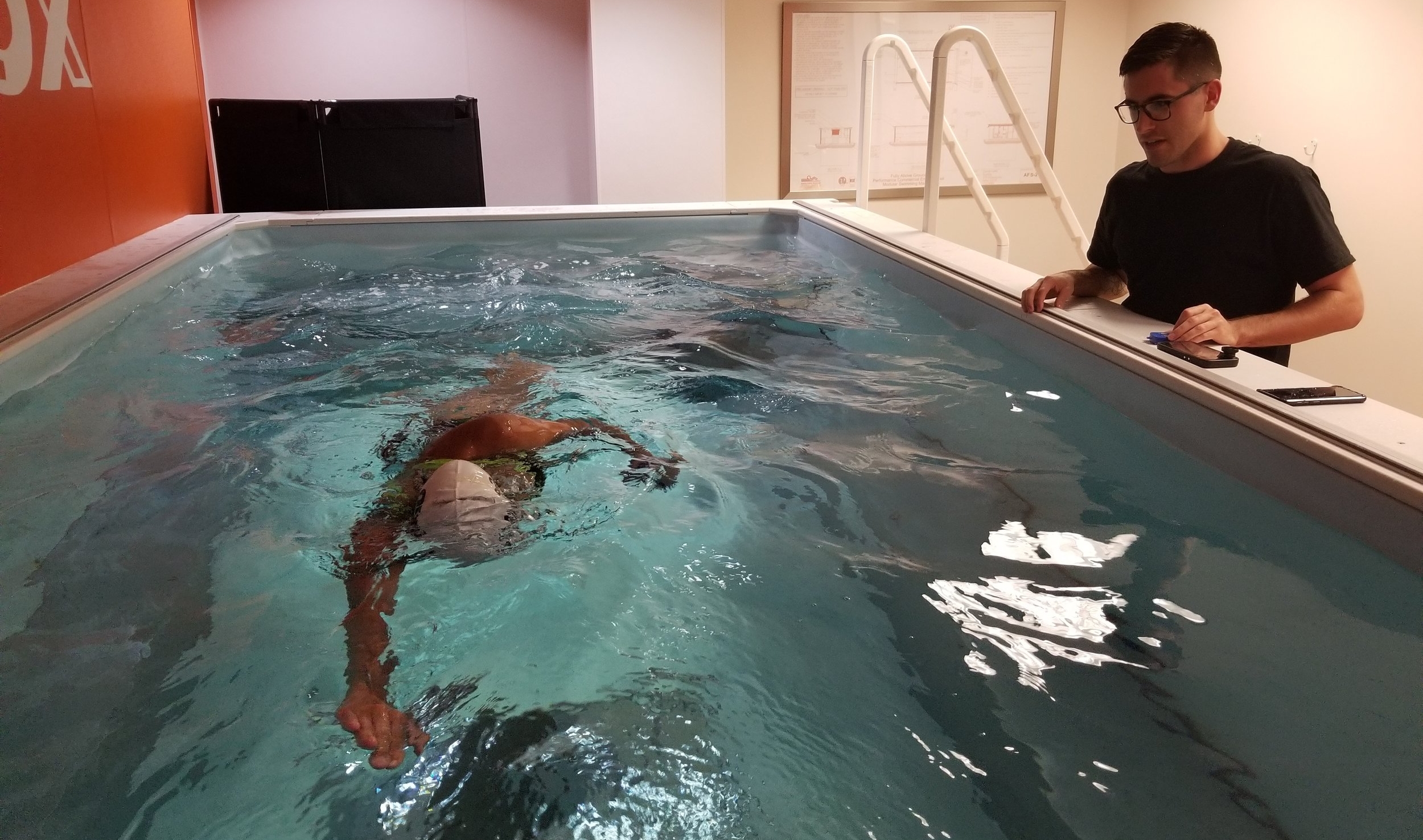
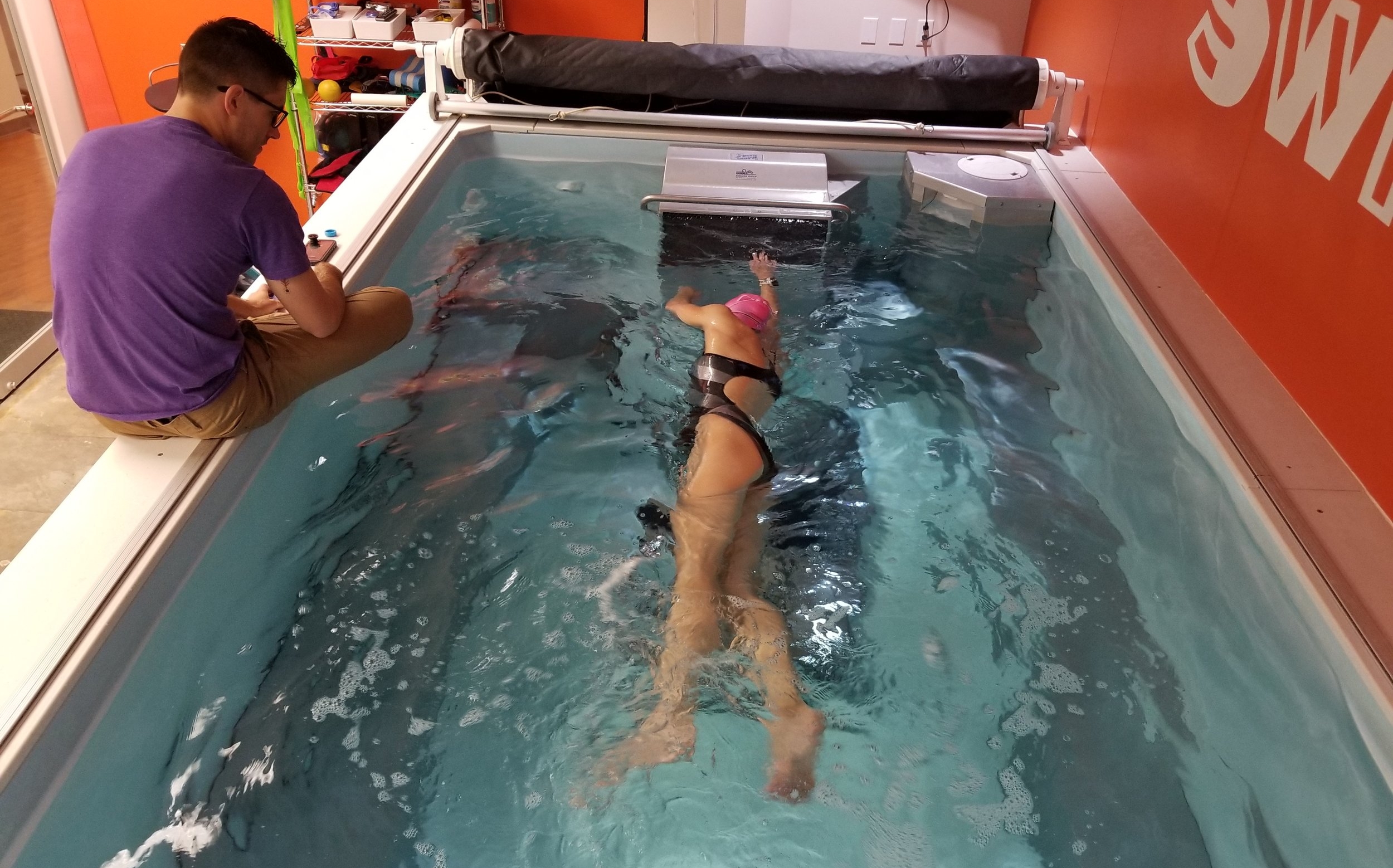
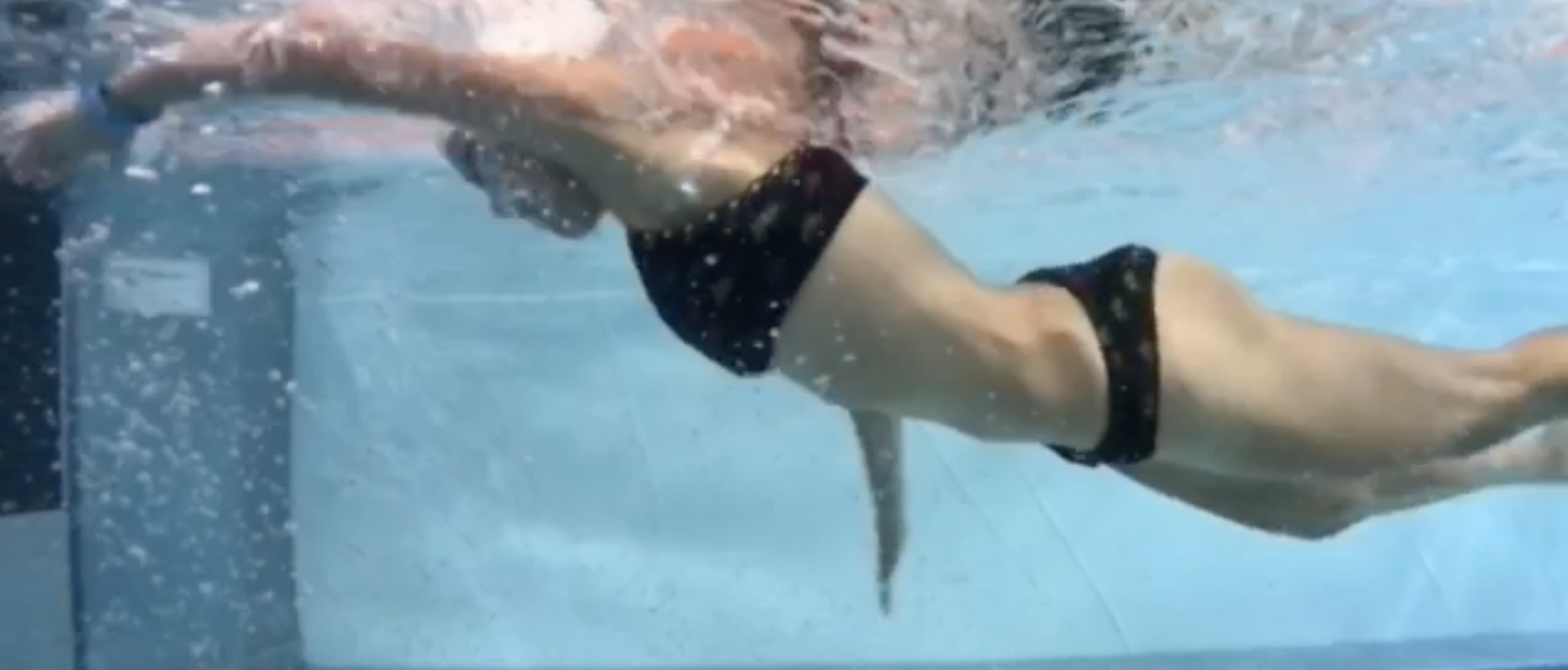
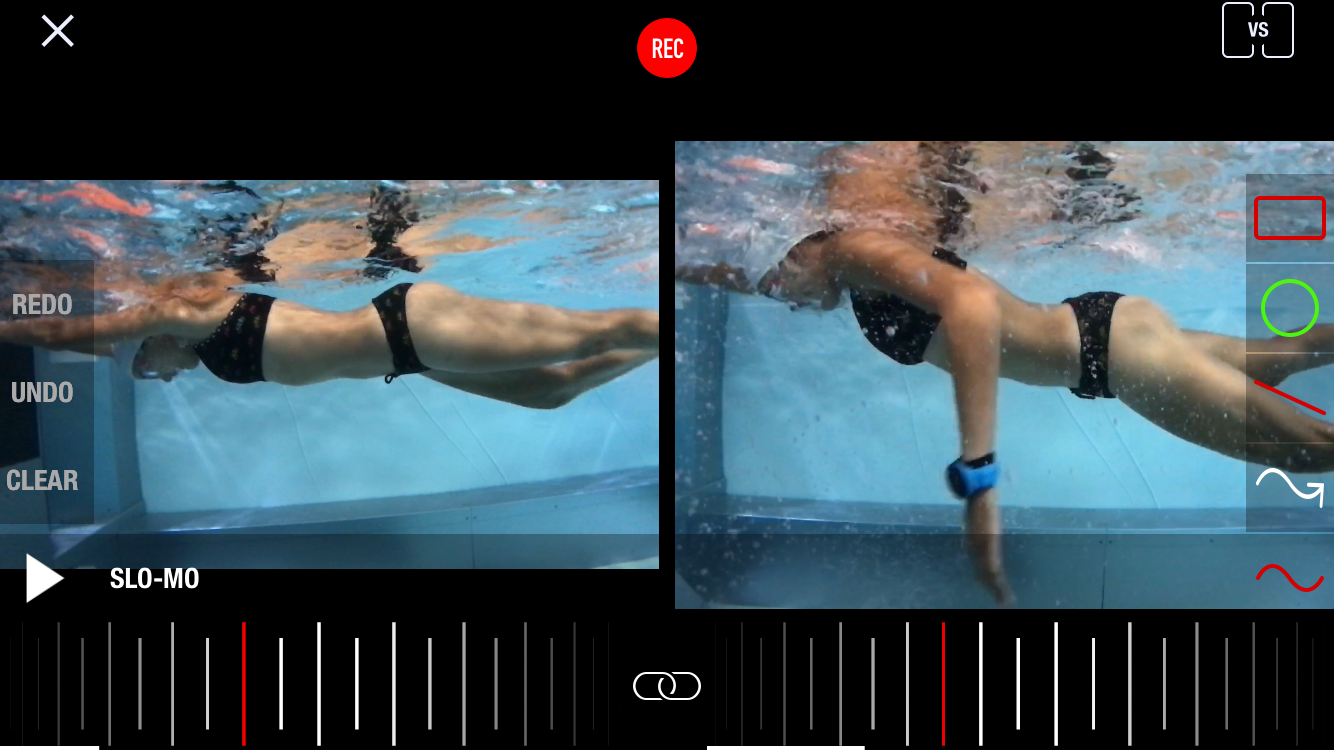
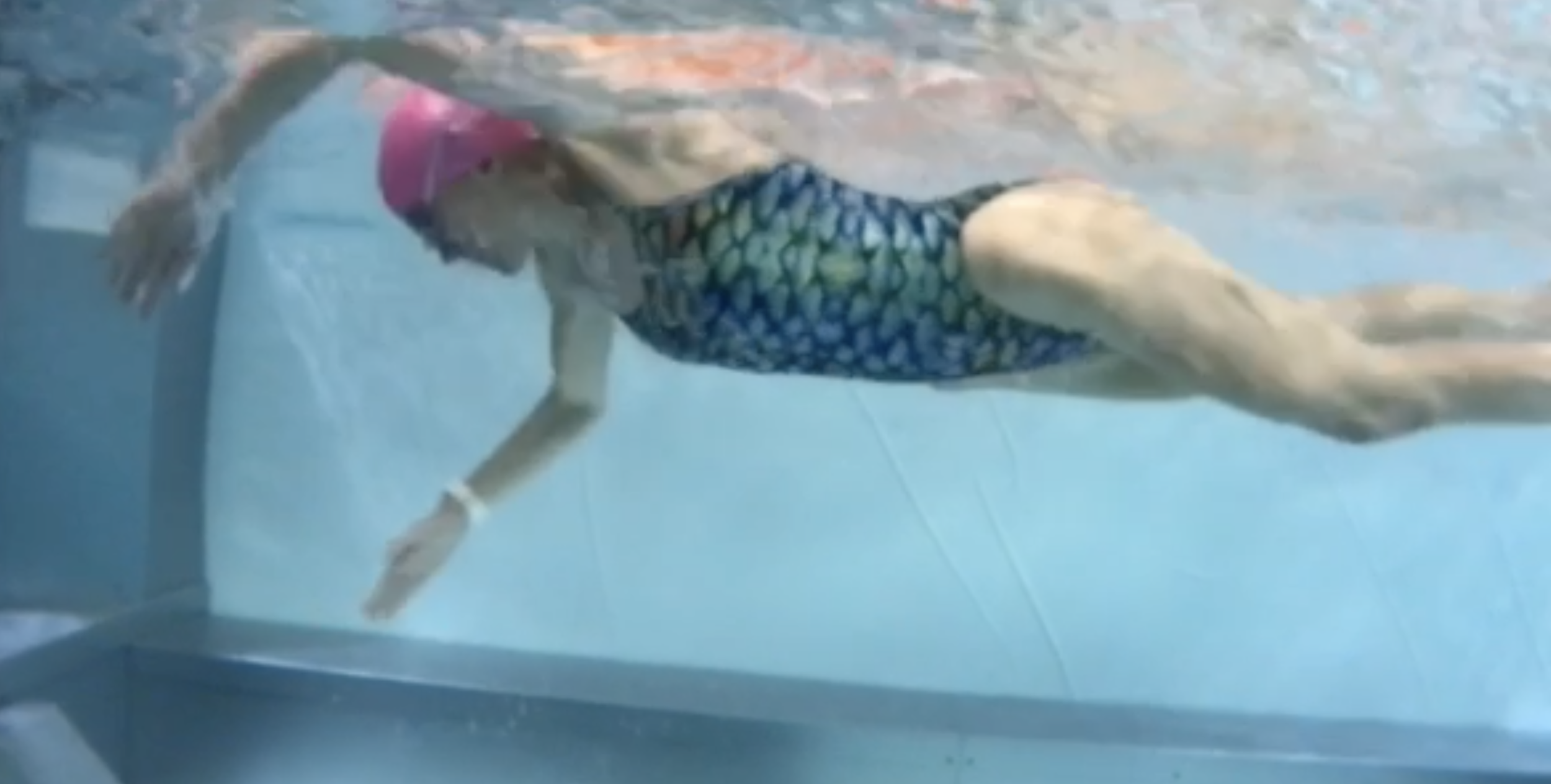
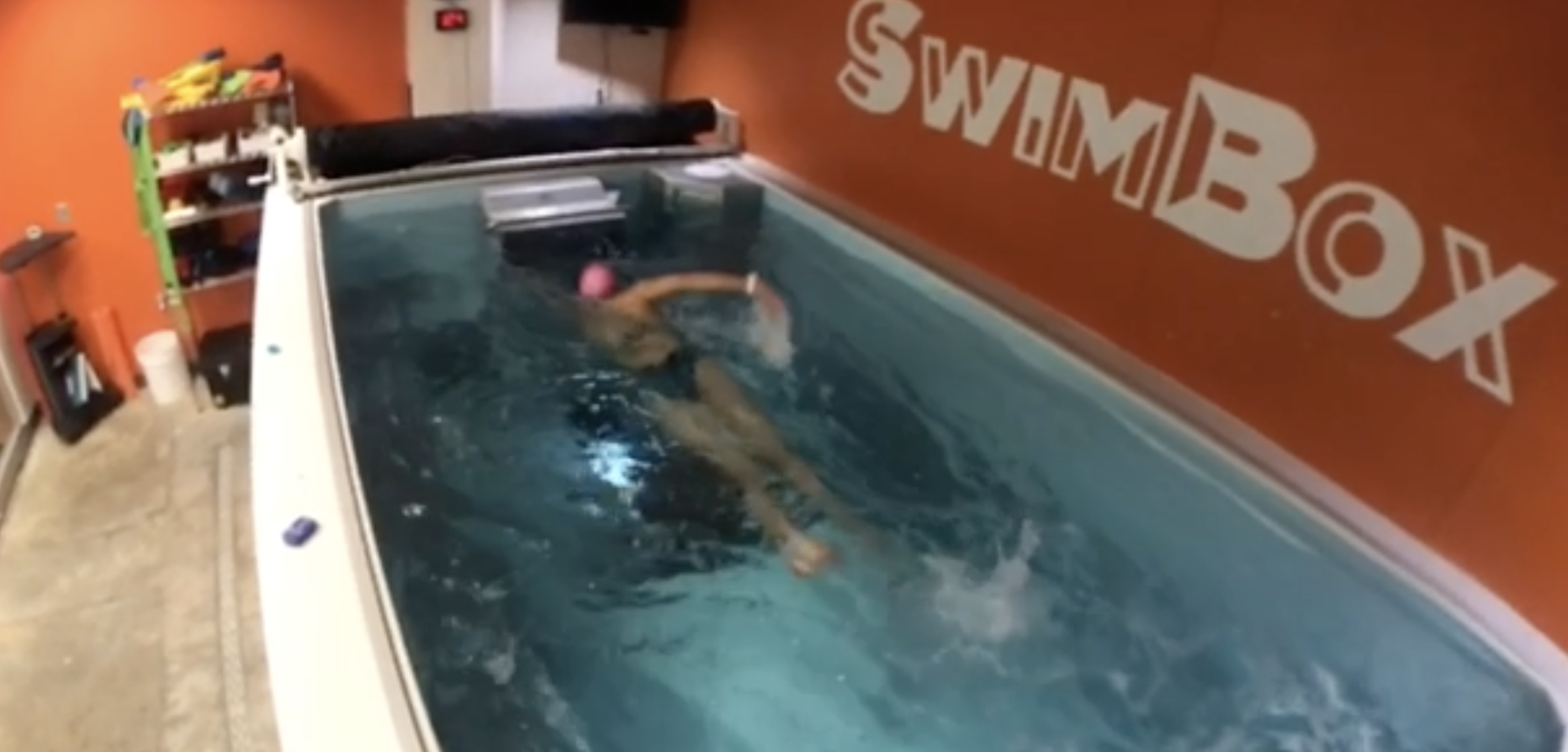
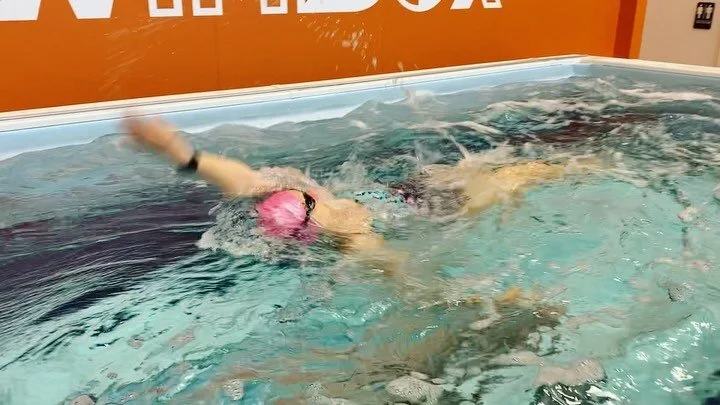
But anywayyyy, I wanted to start off my post about Katie's latest lesson with that little bit of background information so you don't think I'm just writing the same thing over and over again with different pictures. One thing Dan noticed during her recent lessons was that Katie's elbow was moving upwards as a result of her arm exiting the water too early. You want your elbow to stay on the same plane as your torso, not move higher or lower than that.
SwimBox Swim Lessons Swim Team SwimBox Tysons SwimBox Vienna Swim Lessons SwimBox Swimming Lessons

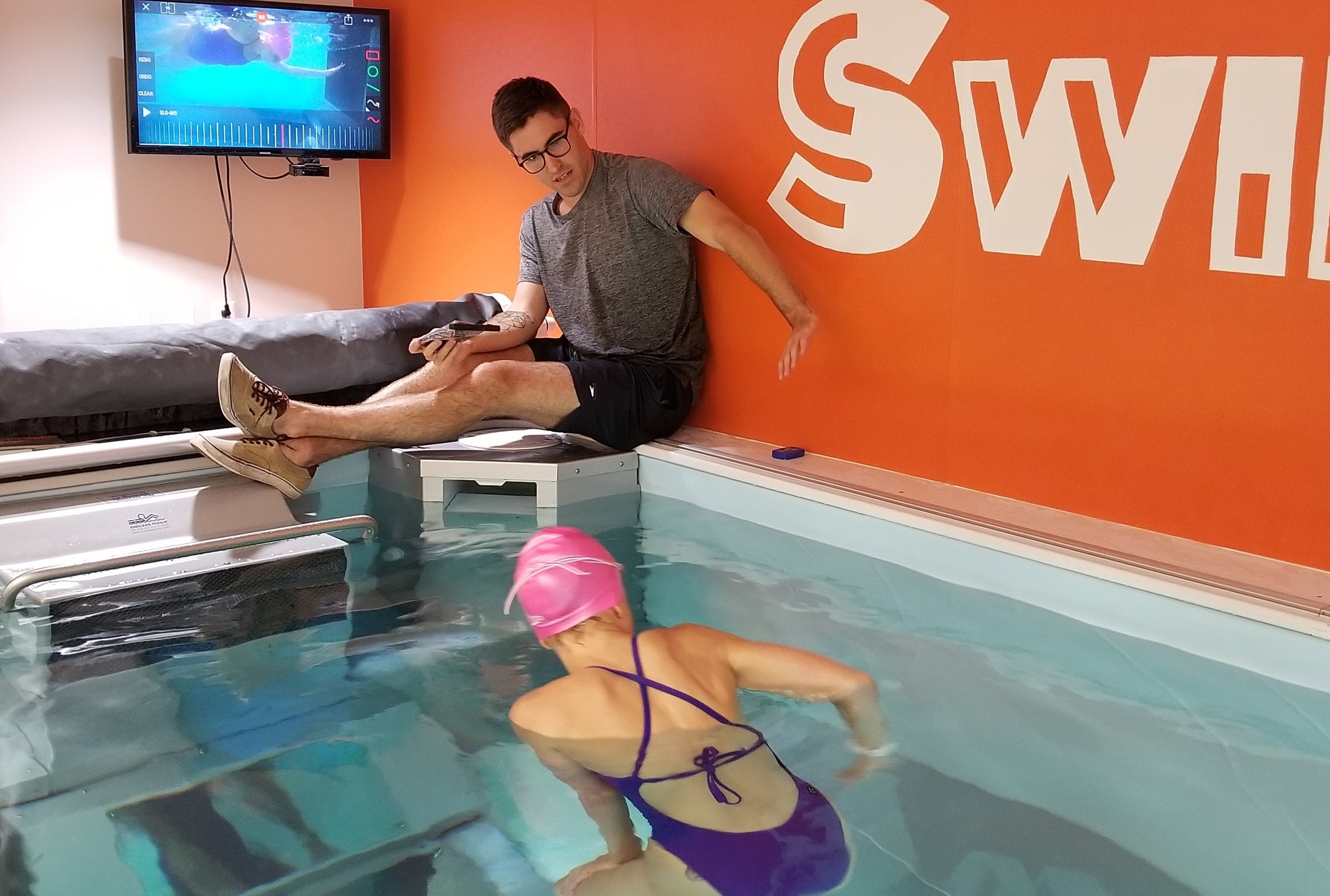
In case you missed last week's post, Katie's lesson focused on connecting the movement of the finish of her stroke into the recovery. You want to keep your palm facing backwards and make a "J" shaped movement from the finish of your stroke into your recovery in order to fully benefit from the propulsion you get from your catch and pull. 

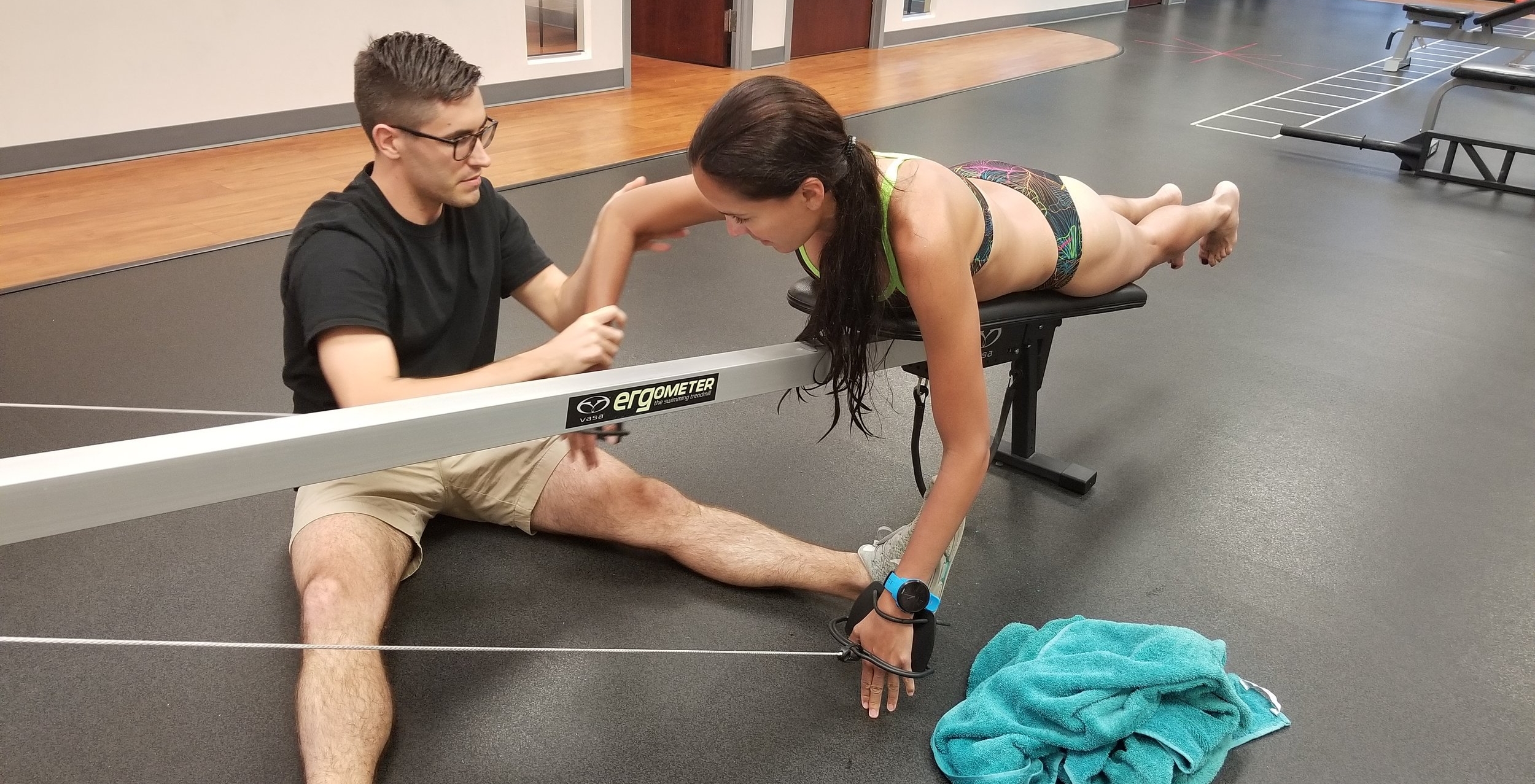
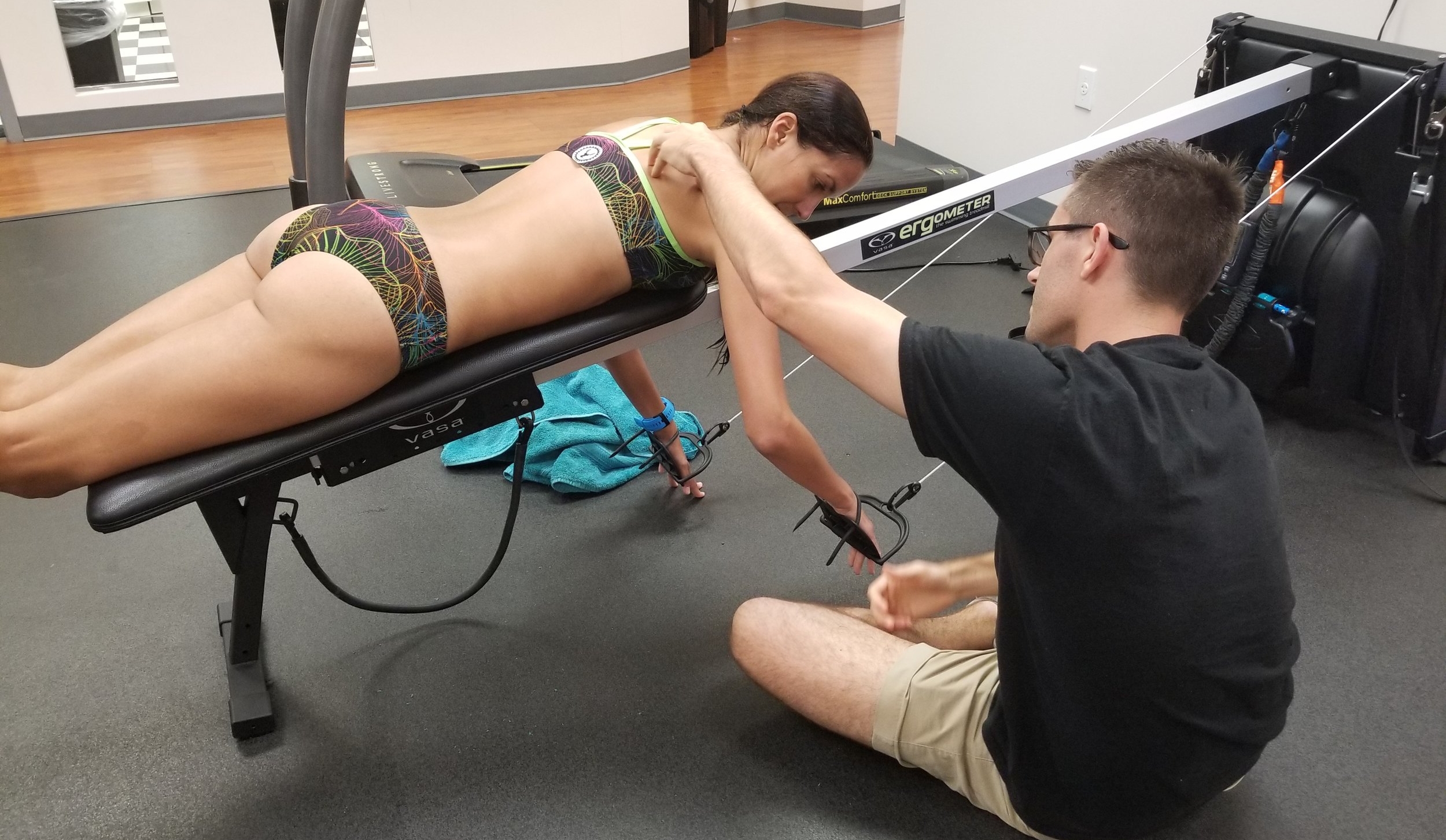
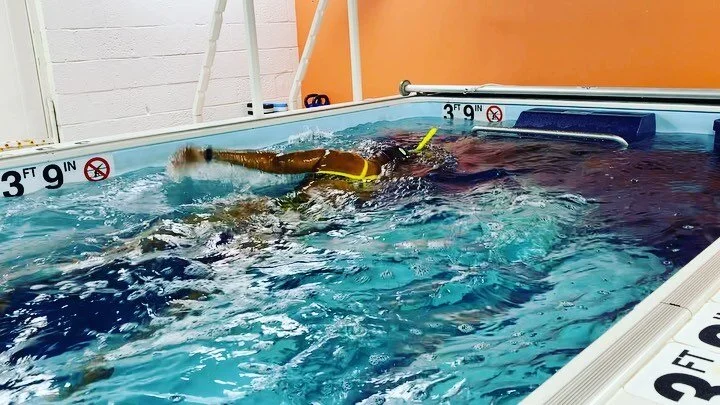
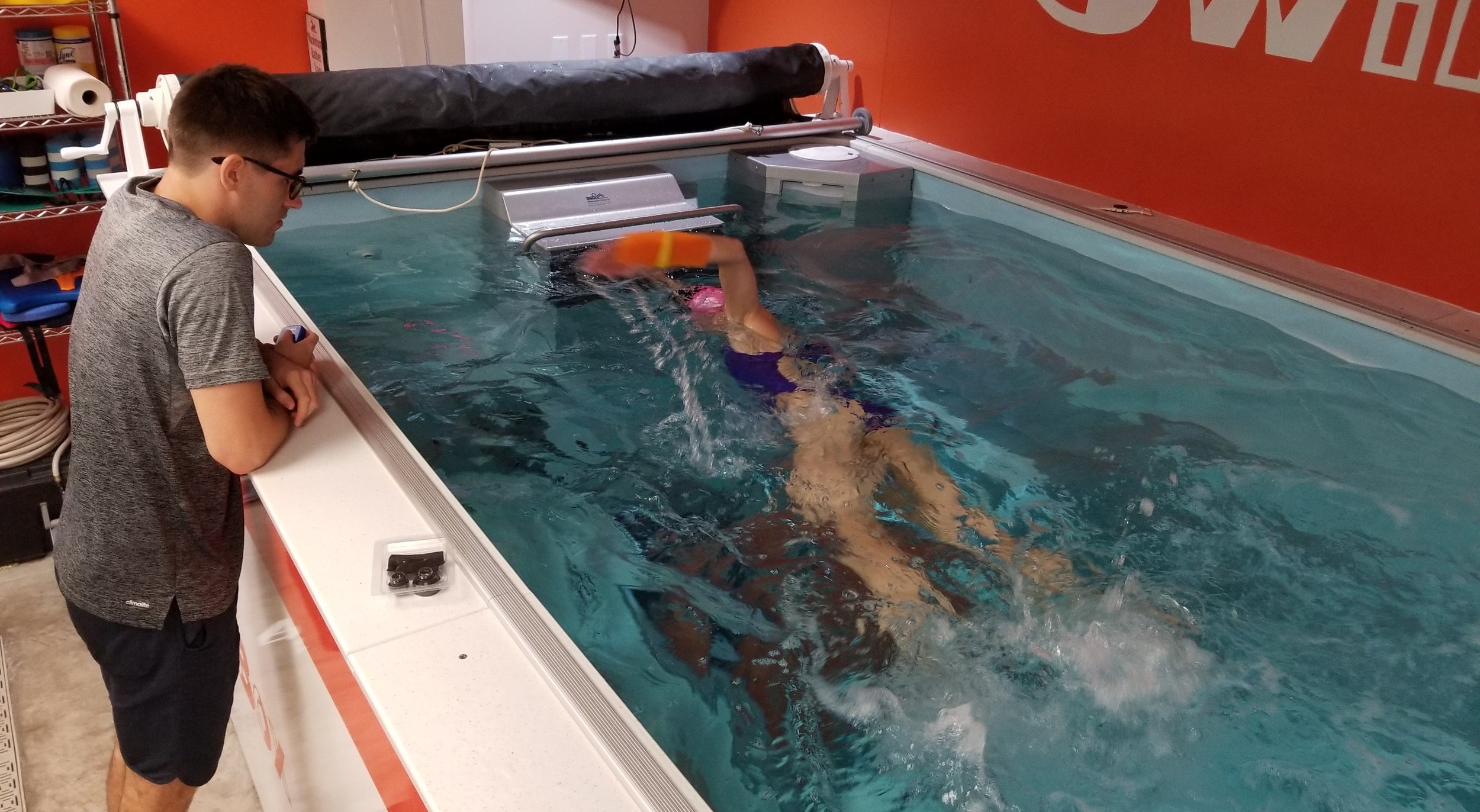
After working on this movement again Dan had Katie focus on the paddle you want to make from your fingertips to your elbow during the catch and pull of your stroke. In order to gain the maximum amount of propulsion from this paddle you want to make sure you're bending at your elbow, not your wrist. To ensure this Dan fashioned together a splint of sorts to prevent Katie from bending at her wrist and losing out on the majority of her paddle.
SwimBox Swim Lessons Swim Team SwimBox Swim Coach Learn to Swim SwimBox Vasa Trainer SwimBox Swimming Lessons

The splint forces Katie to keep her arm straight from her fingertips to her elbow, which creates the largest paddle possible to propel her through the water. The larger the paddle, the more efficient your stroke will become, and the easier it will be to move forward faster. Using the splint gives Katie better body awareness as to what she's looking for when she removes it and swims on her own. Understanding the feeling you're looking for when making a change to your stroke is key to making the change properly and progressing more quickly. 

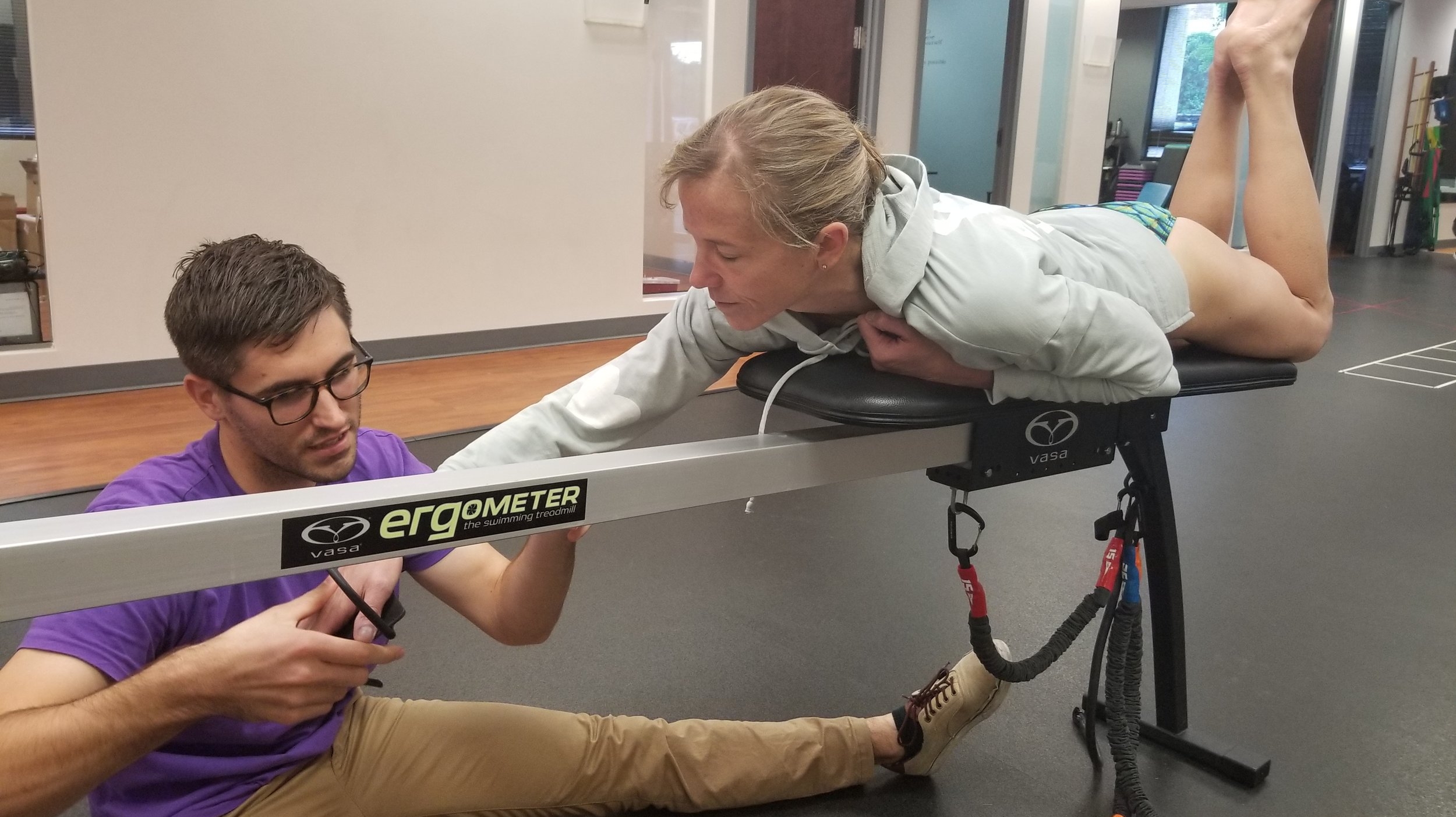
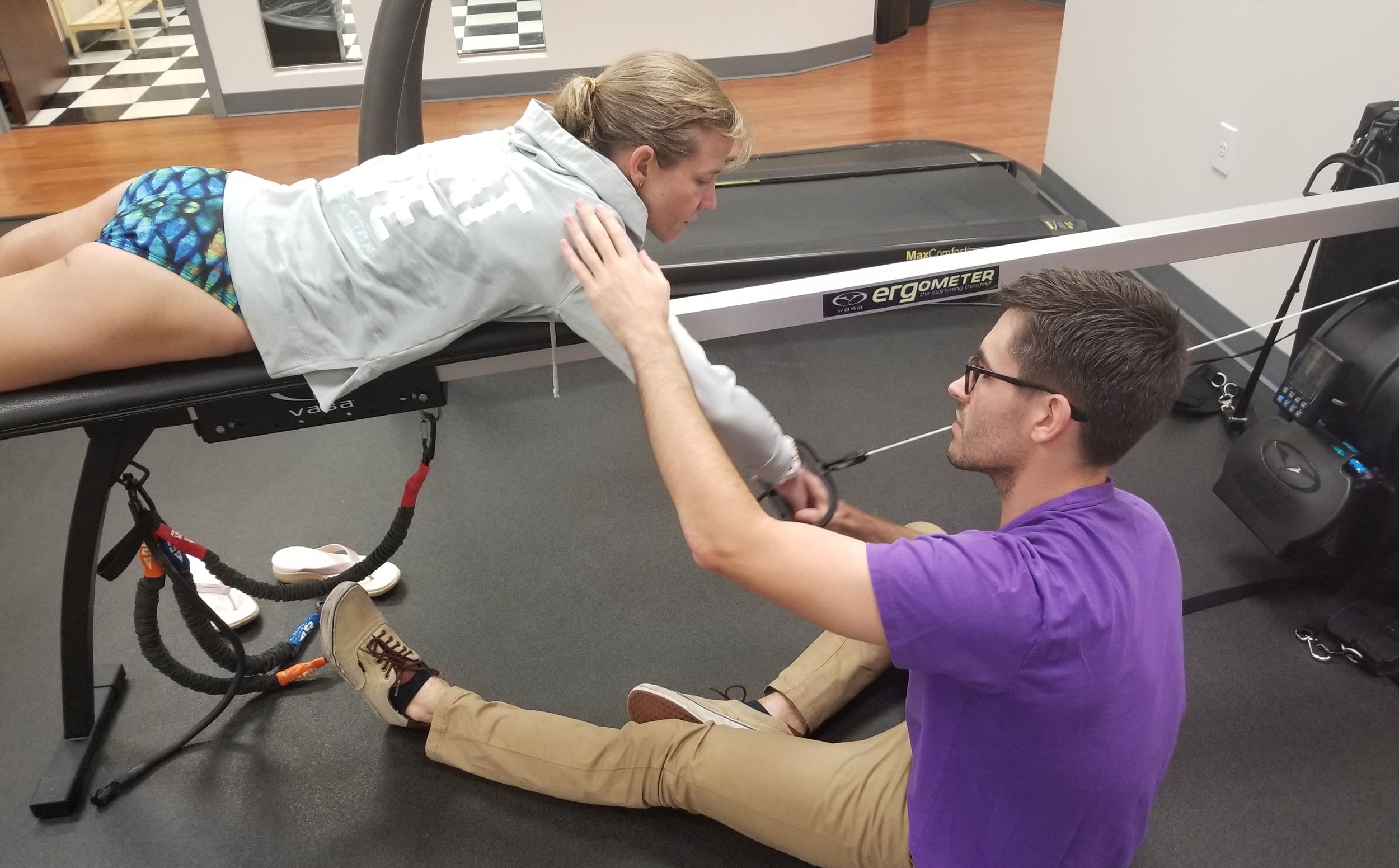
In between her lessons here Katie's doing workouts on her Vasa Trainer SwimErg that she has at home to work on strengthening the main muscles we use for swimming as well as up her endurance. An example of one of her workouts is listed below.

Repeat each three times:

  • two minutes of good catch movement (do butterfly or freestyle catch; no watts needed, just focus on proper movement)

  • two minutes freestyle catch at 20-40 watts (make sure you focus on keeping a good catch movement - keeping proper movement is key, especially when picking up the pace)

  • :15 seconds of freestyle catch at 100+ watts x 6; :30 seconds rest in between each round

Being able to focus on strengthening these movements outside of the pool is such an important piece to training and progressing in your times. The more endurance you gain on the SwimErg the more efficiently you'll be able to move through the water when you hop back in the pool. It's also a great tool to use when you're trying to find proper body awareness.

Stay tuned to see how Flaca's lesson goes this week!
The Best Drills to Perfect Your Open Water Sighting

When you wake up every morning, open your front door, and walk straight into a wall of sticky, uncomfortable humidity, what does that mean? Besides that you want to turn right back around and bask in the refreshingly cool feeling of your air conditioning that is. Summer's here in Northern Virginia! And in the summer open water races and triathlons take over a lot of your calendars, so we thought this was the perfect opportunity to have a refresher course in our favorite sighting drills.

The first place to start, especially if you're learning to sight for the first time, is Alligator Eyes Drill. This is kind of like a modified tarzan drill where you're swimming with your head and shoulders much higher in the water than you normally would. For Alligator Eyes you want to swim with just your eyes above the surface of the water, keeping your nose and mouth in the water, allowing you to see what's in front of you. 

SwimBox Swimming Lessons SwimBox Tysons Swim Lessons SwimBox Vienna Swimming Lessons Swim Coach SwimBox Swim Team

Make sure not to lift your head up too far when practicing this drill, as doing so will quickly drain your energy from having to hold your head up without the help of the water. It's important to know that lifting your head for this drill will cause your hips to drop, increasing your drag/resistance, and causing your stroke to become less efficient. Don't worry, it's just a drill! When you go back to swimming normally, with your head down and your eyes looking at the bottom of the pool, your body will go back to the proper position.

To take a breath simply put your head back down into normal position and breathe to the side, just like you would in your regular freestyle. When practicing this drill in a pool, find something in front of you to use to practice your sighting. 

Uploaded by SwimBox on 2018-07-12.

My next favorite progression for sighting is a Rolling Sight, which is an advanced version and the next step towards sighting in the open water. This is actually the exact way I've come to sight in open water, as it very easily incorporates into a correct freestyle. I used to swim Tarzan Drill every time I got in the open water, and let me tell you, it wasn't pretty. It also zapped my energy and I kind of looked like an injured seal...but anyway, back to the point,.

A Rolling Sight works on adding a sight to your stroke while still swimming your regular freestyle. As opposed to keeping your head up the whole time, like in Alligator Eyes, you want to lift your eyes out of the water every 4-6 strokes. This movement is meant to quickly sight an object in the distance, most likely a buoy if you're racing, to keep you on course. Keep in mind this sight is not meant for you to be able to see everything perfectly! It's a quick look up to check where you are and keep you swimming in the right direction.

Play around with this one the first time you try it out to get the right number of strokes for you. Some people swim straight without evening trying and only need to sight every 8-10 strokes, whereas others need to sight more frequently. My stroke count in between sights varies depending on how choppy the water feels and if I'm feeling jostled around. There's no right number, just whatever feels comfortable to you. However, it's always better to sight more frequently than less frequently to stay on the safe side. 

SwimBox and Vasa Trainer Project: Katie's Third Lesson

In case it's not clear at this point, these ladies are really dedicated to improving their swimming! We've been seeing them as close to once a week as all of our schedules will allow, and both Katie and Flaca are making huge improvements to their stroke technique with our swim lessons and work on the Vasa Trainer SwimErg. If you haven't already make sure to check out the breakdown of Flaca's lesson from last week here to read about her work on elbow position and timing of her catch.

The main focus of Katie's lesson this week was on her finish and recovery. With so much emphasis on having and maintaining a proper catch position, the finish of your stroke into your recovery is often an overlooked aspect of freestyle. In order to fully benefit from the propulsion you get from your catch and pull, you need to keep your palm facing backwards and make a "J" shaped movement from the finish of your stroke into your recovery. For clarification, the recovery is the portion of your stroke from when your hand exits the water after you finish your pull to when you place your hand back in the water to start your next catch. Essentially, the entire time your arm is out of the water is your recovery.

SwimBox Swimming Lessons Vienna SwimBox Falls Church SwimBox Swim Lessons Swim Team Tysons
SwimBox Swimming Lessons Fairfax Swim Lessons SwimBox Falls Church SwimBox Tysons Swimming Lessons

To practice and gain better understanding of the "J" shape we're looking for, Dan had Katie work on just the finish of her stroke without actually making any full stroke movements. Lying face down in the water with her hands at her sides, Katie made an egg beater motion with each arm, only pushing backwards and slightly out using her forearm and hand. Dan has his hand in the water to give Katie something to aim for in order to give her direction as to where we want her to finish her stroke.

It's commonly thought that you want to pull back and finish your stroke in a straight line. And in a perfect world, that would make sense. BUT, because your hips are rotating during the entirety of your stroke, it pulls your arm and hand inward towards your body. This movement prevents you from pulling back in a straight line, and will even result in recoveries starting behind you or stacked directly on top of your torso. We use the "J" shape movement to keep your paddle in a straight line and to keep your palm facing back - not up towards the surface - in order to connect the fluid motion into your recovery. The finish of your stroke, the "J" shape, is the beginning of your recovery.

SwimBox and Vasa Trainer Project: Lesson 2 w/ Flaca Guerrero

Time for week 3! In case you're just joining us, make sure you go back and read about our first and second lessons in our SwimBox and Vasa Trainer project we're currently working on with Katie Gage and Flaca Guerrero. Unfortunately Katie's daughter was sick this week and she was unable to come in, so we worked solely with Flacca on catch position and the timing of the movements of her catch, pull, and rotation.

SwimBox Swimming Lessons Tysons Swim Lessons Vienna Swim Lessons SwimBox Swim Team

At this point in our project I'm sure you've noticed a lot of repetition, and you're right. Our lessons are full of do this, do it again, again, make a correction, do it again, again, and so on. Repetition of small movements helps reinforce the movement as well as gives you more body awareness of how you want to feel in the water. We also drive concepts into the ground to make sure you're keeping proper positioning even when you're tired and frustrated. It can be a hard process, but one that definitely pays off. 

One of the biggest things Dan noticed we need to correct with Flaca's stroke is that her wrist was always beating her elbow to the finish of her stroke. When that happens she's losing the power of her catch entirely and her arm becomes drag in the water. To work on this Flaca practiced hinge drill, which is where you float on your stomach with your arms in a superman position, and the only movement you make is in your forearm by beginning your catch. This drill is great to show the amount of power you develop from your catch as well as the position you're looking for when your hand first enters the water to start the catch.

SwimBox Swimming Lessons Arlington Swim Lessons Fairfax SwimBox Tysons SwimBox Swim Lessons Falls Church

After working in the pool for a bit we moved over to the Vasa Trainer SwimErg (for the first time with Flaca!) to have an in depth look at her catch and pull. Being able to work with clients and actually move them into the proper position is one of our favorite things about the SwimErg. There's nothing else out there that lets us do this while at the same time being able to mimic the resistance of the water. This week Dan worked with her on using her elbow to bring her arm forward and keeping her elbow from dropping.

When your hand enters the water you want to make sure your elbow is the driving force that has moved your arm forward to get to that position. By keeping your elbow up and not letting it drop (which is the natural movement your body wants to make) your hand will be setup to enter the water in proper catch position. This will prevent you from having your hand enter the water, and THEN move it into proper catch position. Swimming is a sport of centimeters, and every tenth of a second counts, so setting this up properly adds up to quite a bit of time that you would have wasted otherwise. 

SwimBox Blog Swimming Blog Swim Lessons Fairfax SwimBox Swimming Lessons Tysons SwimBox Swim Lessons Falls Church SwimBox

A very important thing to be mindful of when focusing on not letting your elbow drop is that you don't start to make these movements with your shoulder joint. As you move from your catch into your pull and the finish of your stroke make sure your shoulder blade is sliding downward towards your heels. This will ensure you're utilizing your back muscles instead of your shoulder joint, which prevents injury as well as gives you a greater power in the water.

SwimBox and Vasa Trainer Project: Lesson 2 w/Katie Gage and Lesson 1 w/Flaca Guerrero

Week 2 is in the books and we've already made a ton of progress! Katie Gage came in for her second lesson and focused on rotation, and we had Flaca Guerrero jump in the pool for the first time and begin her work on her head/body position. Flaca wasn't able to get on the Vasa Trainer just yet, as we need to fix a few foundational things first, but we'll get there soon.

SwimBox Swim Lessons Tysons Swim Lesson Vienna Swim Lessons Falls Church Swimming Lessons SwimBox

What would you say if I told you Katie didn't rotate before her lesson this week. Crazy, right? It's actually a lot more common than you'd think, because rotation can get a bad reputation. The key is to not over-rotate. For a swimmer who uses a relaxed recovery, the sweet spot is to have a 45 degree rotation. This amount of rotation allows the mobility to take a proper full stroke (catch, pull, finish, recovery), as well as a proper breath. Swimmers that use a straight arm recovery can get away with less rotation, but probably no less than 35 degrees. And as you become a better/stronger swimmer you can comfortably alternate between both types of swimming depending on the situation.

In Katie's case her lack of rotation was causing an improper catch position. Because of this improper position she was not able to develop and maintain a paddle with her hand/forearm to propel her through the water. To have a proper catch, and in turn create a strong paddle, you want to start your rotation as soon as you start your catch. 

SwimBox Tysons Swimming Lessons Vienna SwimBox Swim Lessons Falls Church SwimBox

Back to the SwimErg! After focusing on rotation and the proper timing we hopped out of the pool to do some catch position exercises. One of our favorite things about the Vasa Trainer SwimErg is that we can focus on small movements without making you do the entire stroke. This makes it easier for your brain to understand the change you're trying to make and allows you to make changes faster than you would be able to otherwise. It's the same concept we use when we work on something in the pool and have our clients use a snorkel, because it takes the breath out of the equation and allows you to focus on the task at hand that much better.

For Flaca's first lesson we had her get in the pool and see her stroke for the first time. This allows us to see the pros and cons of her stroke and figure out what we need to start working on first. With Flaca, the first things our instructor Dan noticed were her head position, body position, and sinking legs.

SwimBox Swimming Lessons Falls Church Swim Lessons SwimBox Swim Team SwimBox Swim Lessons Vienna

By making a small change in Flaca's head position it started to fix her sinking torso and legs, as well as keep her much more streamlined as she moves through the water. Before we put her on the SwimErg it's important to make some foundational changes to her stroke and practice those in the water. Trying to change too many things at once will overload your brain and most likely will result in no change at all. It's very important to us to focus on injury prevention above all else, and making these changes before moving forward will help keep Flaca swimming safely for the rest of her life.

SwimBox Swim Lessons Vienna Swimming Lessons Tysons SwimBox Swim Lessons SwimBox

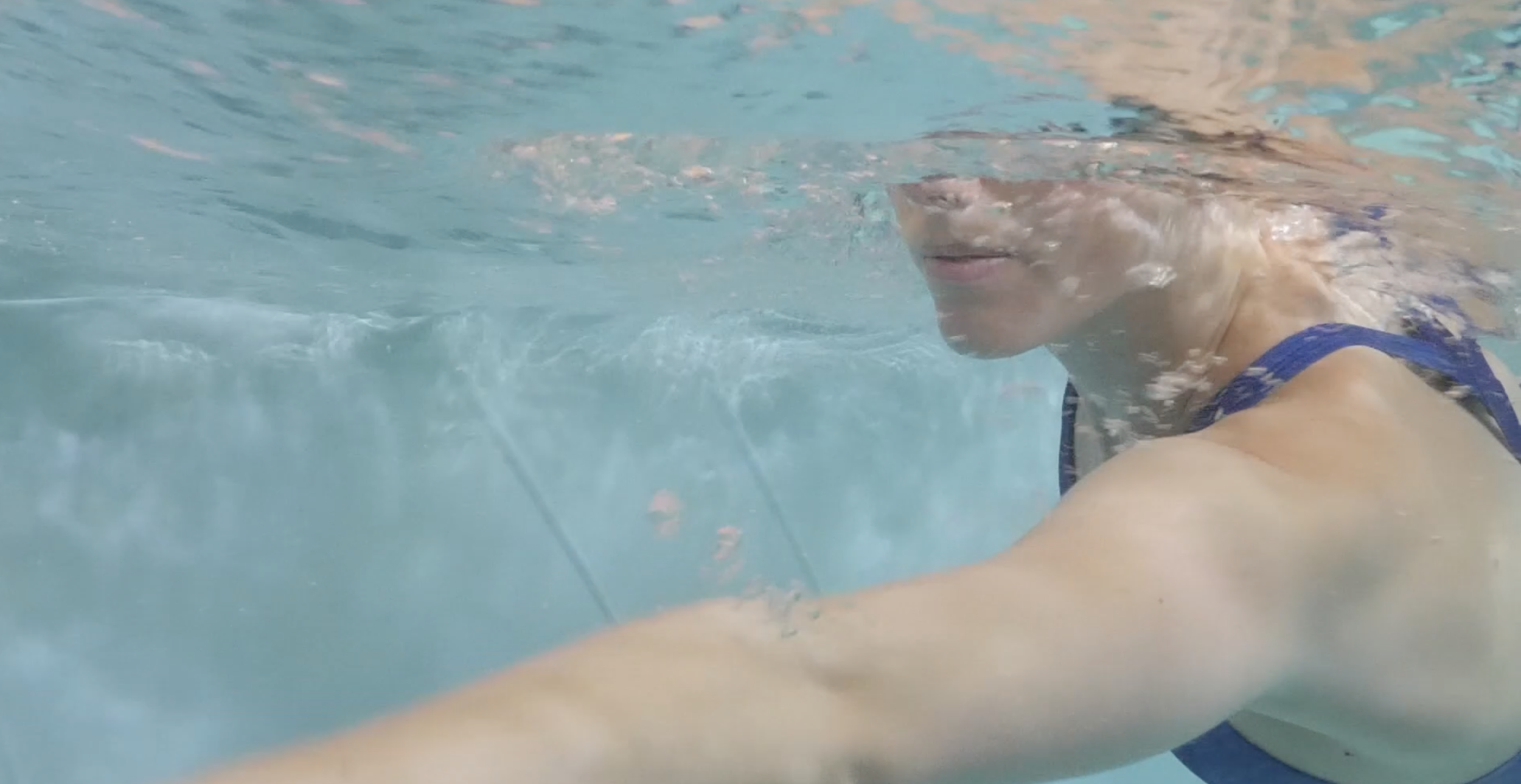
By having Flaca look downward towards the bottom of the pool, as opposed to slightly forward and looking ahead of herself, she's already made huge changes to her body position and sinking legs. Take a look at the picture above! The before shot is on the right and the after shot is on the left. Because this is such an important part of a strong, injury free, and efficient freestyle Dan had Flaca work on this for her entire lesson. Can't wait to put her on the SwimErg next week!

SwimBox and Vasa Trainer Project: Lesson 1 with Katie Gage

Yesterday marked the first day in our SwimBox and Vasa Trainer lesson plan for athlete Katie Gage!  Over the next few months we'll be working with both Katie and her friend/swim training partner Flaca Guerrero on their swim technique. During this project we'll be combining swim lessons, swim technique training, and Vasa Trainer SwimErg workouts to help improve their technique, strength, and overall performance in the water.

SwimBox Tysons Swim Lessons Fairfax SwimBox Fairfax Swim Lessons Tysons

Katie started her first lesson off by jumping in the pool so we could see her swim. One of the keys to the swim lessons at SwimBox is checking our swimmers' starting point. Once we have that our instructor pinpoints the pros and cons of the swimmer's stroke, explains these to the swimmer, and then develops a lesson plan of where to begin and how we'll progress forward. So after our instructor Dan McGuire watched Katie swim he decided her catch was what needed to be worked on first. What did that mean? To the Vasa!

SwimBox Swim Lessons Tysons Swim Lessons Falls Church Swimming Lessons Vienna

If you're not familiar with the Vasa Trainer the one we work with is their SwimErg. The SwimErg is a machine that allows you to focus on your technique while at the same time strengthening your endurance and power. Like a rowing erg, the SwimErg has an adjustable airflow system that simulates the resistance you feel while swimming in the water. It's really a great tool to help us break down swimming technique and focus on one aspect at a time. It's also a rare opportunity to be hands on in swimming, which can be extremely helpful when a swimmer is having trouble figuring out a new movement they need to make with their body.

With Katie on the SwimErg we spent the rest of her lesson explaining the movements behind a proper, and safe, catch position. When I refer to catch position here I'm talking about hand position as it enters the water, arm/elbow position as she catches and pulls through the water, and shoulder position/movement while pulling through the water to the finish of the stroke.

SwimBox Swim Lessons Tysons Swimming Lessons Vienna Swim Lessons SwimBox Tysons

Quick tip? You want your shoulder blade to glide down your back towards your back pocket (imagine that you're wearing jeans while swimming, but don't actually try this...it's not fun). Keeping this movement allows your body to engage the proper muscles for your catch and pull, as well as prevents you from utilizing your shoulder joint to muscle through the water. Not only is the VASA a great tool to help us gain/work on proper swimming technique, but it gives us the perfect avenue to show you how to make the movements to stay injury free.

Now that Katie has a better grasp of the proper movements she needs to be making in her freestyle catch and pull, we gave her some workouts to do on the Vasa Trainer SwimErg she has at home. Stay tuned next week to read about Flaca's first lesson!

Pull Ups and Push Ups for Days

When you wake up every week day at 3:45am and head into swim practice, what's the best thing that can happen? DRYLAND. Dryland was the best surprise I ever got when I used to walk in the door to my morning swim practice in my high school days. Why? Because it meant I didn't have to plunge into the depts of the frigid, ice-like water that was the pool at George Mason University (don't try to tell me I'm a wimp; that's the coldest water at any pool I've ever swam at). They used to (not sure if they still do) keep their water at 78-79 degrees, which is basically the equivalent to dry ice in the swimming world. 

So when dryland days rolled around and I got to wake up at o'dark thirty but NOT jump directly into the icy waters akine to that of Antarctica I was one happy kid. But when I transitioned into working with mostly triathletes and found out they didn’t do dryland exercises, or really knew what the word dryland meant (apparently that’s a swimming term), I decided something had to be done about that. How could I let some of the happiest workouts I used to have when I was younger go unrecognized? Anyway, I’ll stop my rambling and reminiscing and move on to the meat of this post. The best dryland exercises swimmers can do to to benefit their swimming: pull ups and push ups.

SwimBox Swim Lessons Swimming Class Swim Lessons Fairfax VA

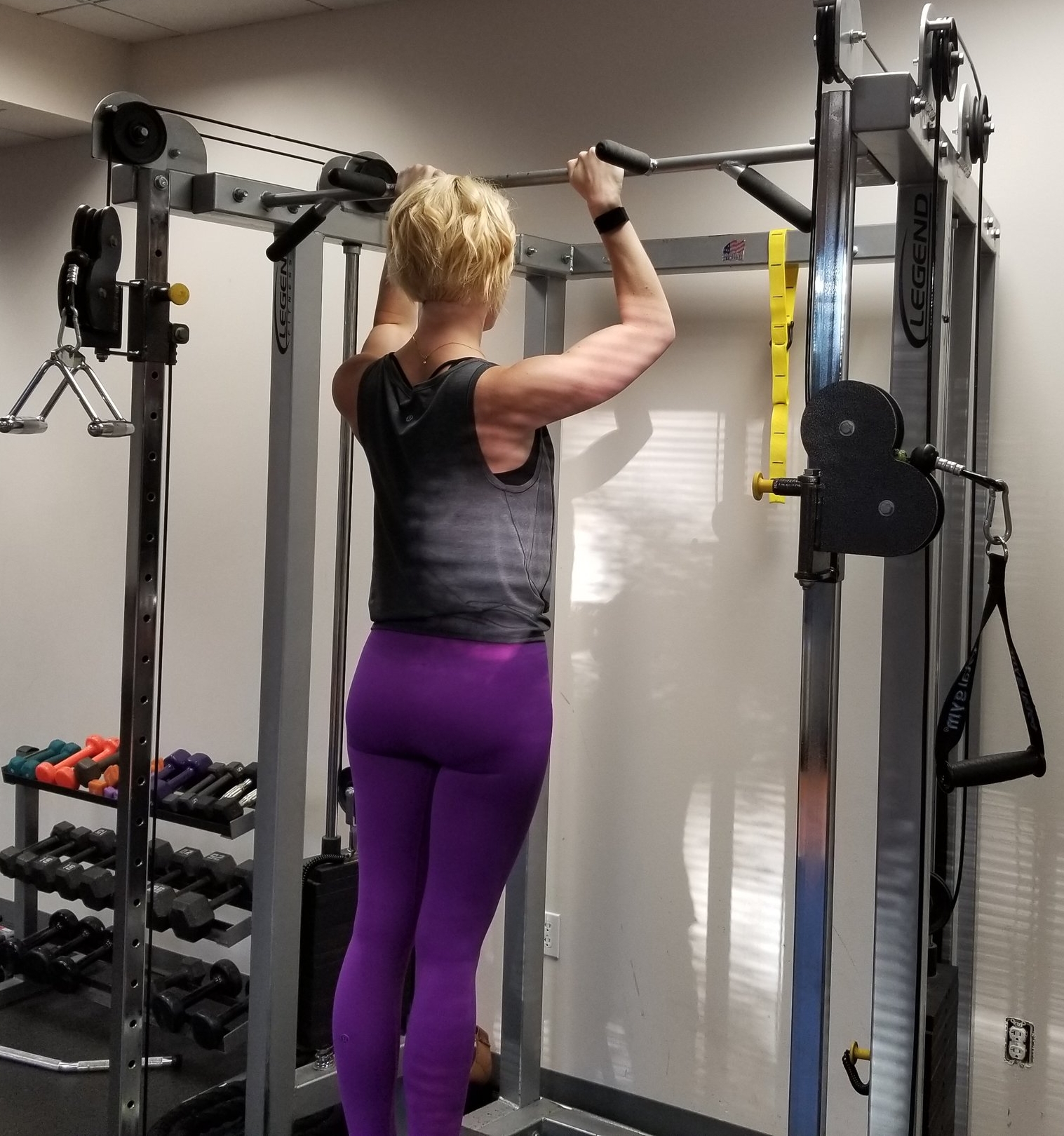
Pull ups are really great because they focus on strengthening the same muscles you use during freestyle without needing consistent technical expertise. Meaning that you can safely do them by yourself without a coach watching over your every move. That being said, you should definitely start these exercises with a coach present to make sure you're starting with good form. Having good form is one of the keys to making sure dryland exercises are giving you the most benefit, as well as keeping you injury free.


Pull ups work your back, rear shoulders, and forearms. This move also focuses on strengthening your lats better than any other exercise on the market, which is one of the main muscles used during your freestyle pull. You want to start with your hands shoulder width apart, palms facing away from you. While keeping your shoulders back and down, try to pull your elbows toward the ground. This is my favorite cue to use to help make sure you're engaging the proper muscles for a pull up.

SwimBox Swimming Lessons Vienna Swim Lessons Fairfax Swim Lessons Falls Church

Now if you’re like me and have trouble doing pull ups without assistance, then your best place to start off with is negatives, which strengthen the same muscles without having to actually pull your body up from the ground. A negative is a movement where you stand under a pull up bar, use a box/stool to jump up from and grab the bar, placing your hands slightly wider than shoulder width apart with palms facing away from you. Using the momentum from your jump, pull yourself upward until your chin is above the bar. This is your starting position. Now slowly, and with control, lower yourself while keeping your core tight and focusing on using your lats to bring you back down to the box/stool. Make sure you keep your shoulders and back and down while lowering yourself. This move might sound easy but it can definitely be a tough one. Whenever I do these I’m usually sore for a few days afterwards.

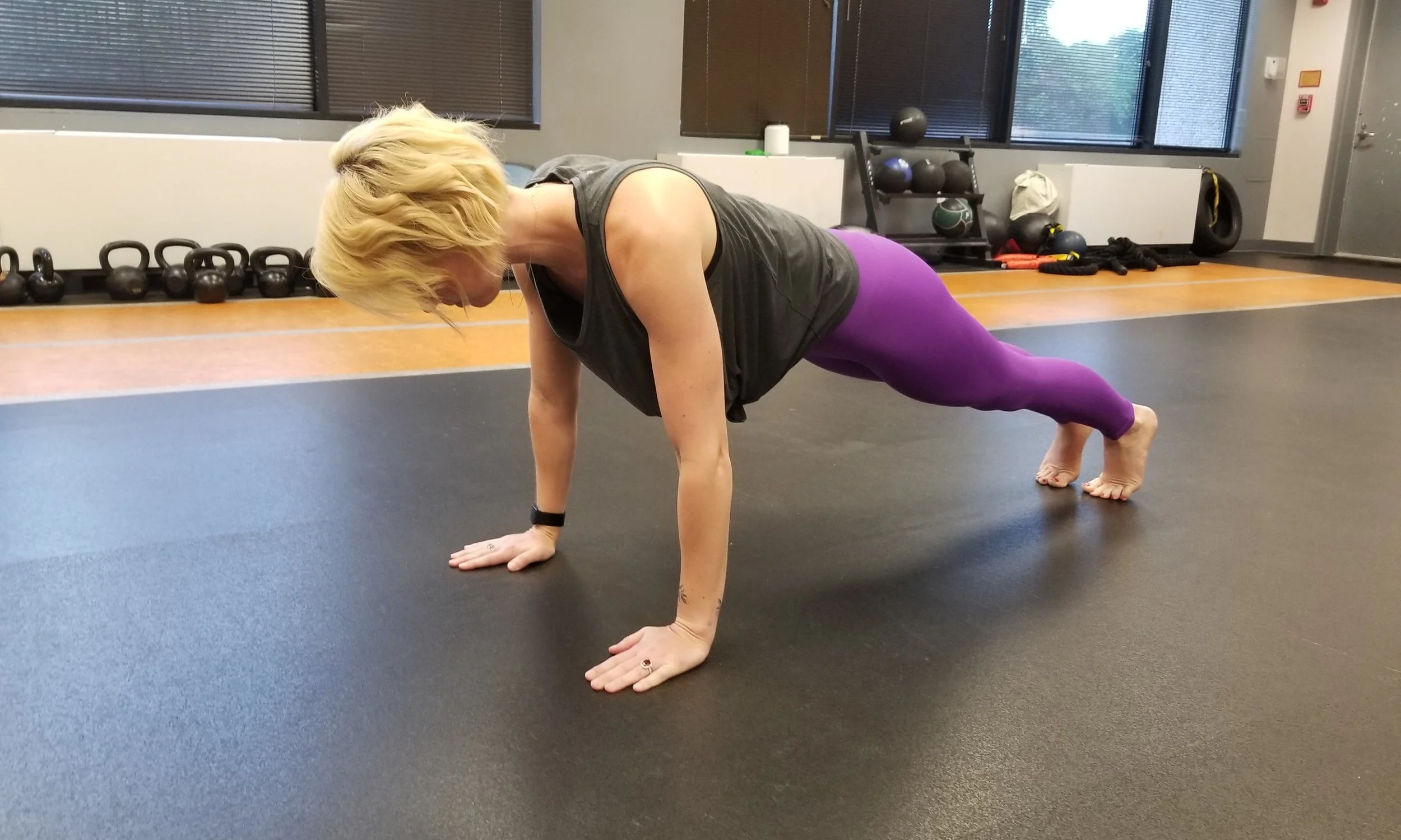
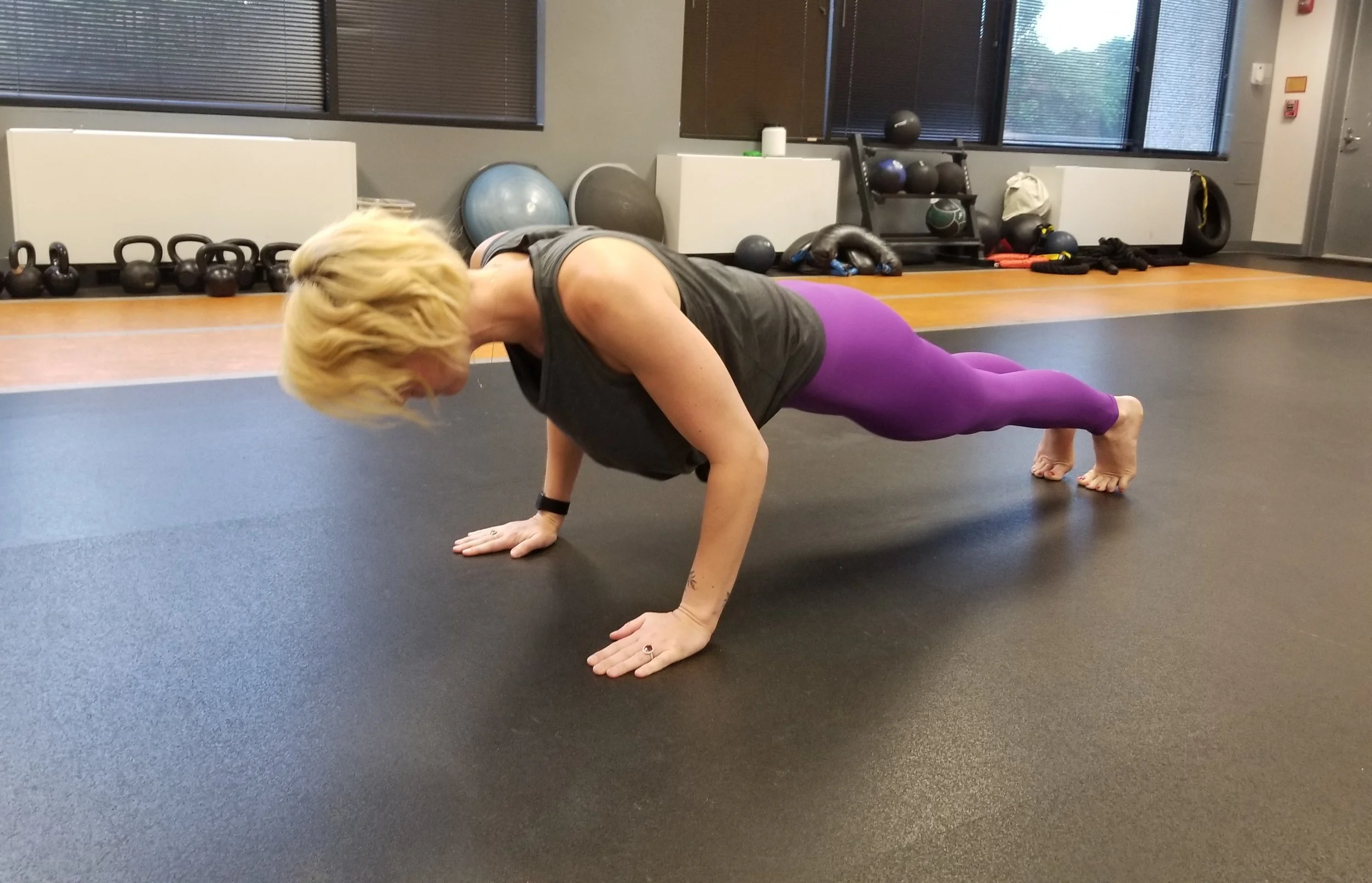
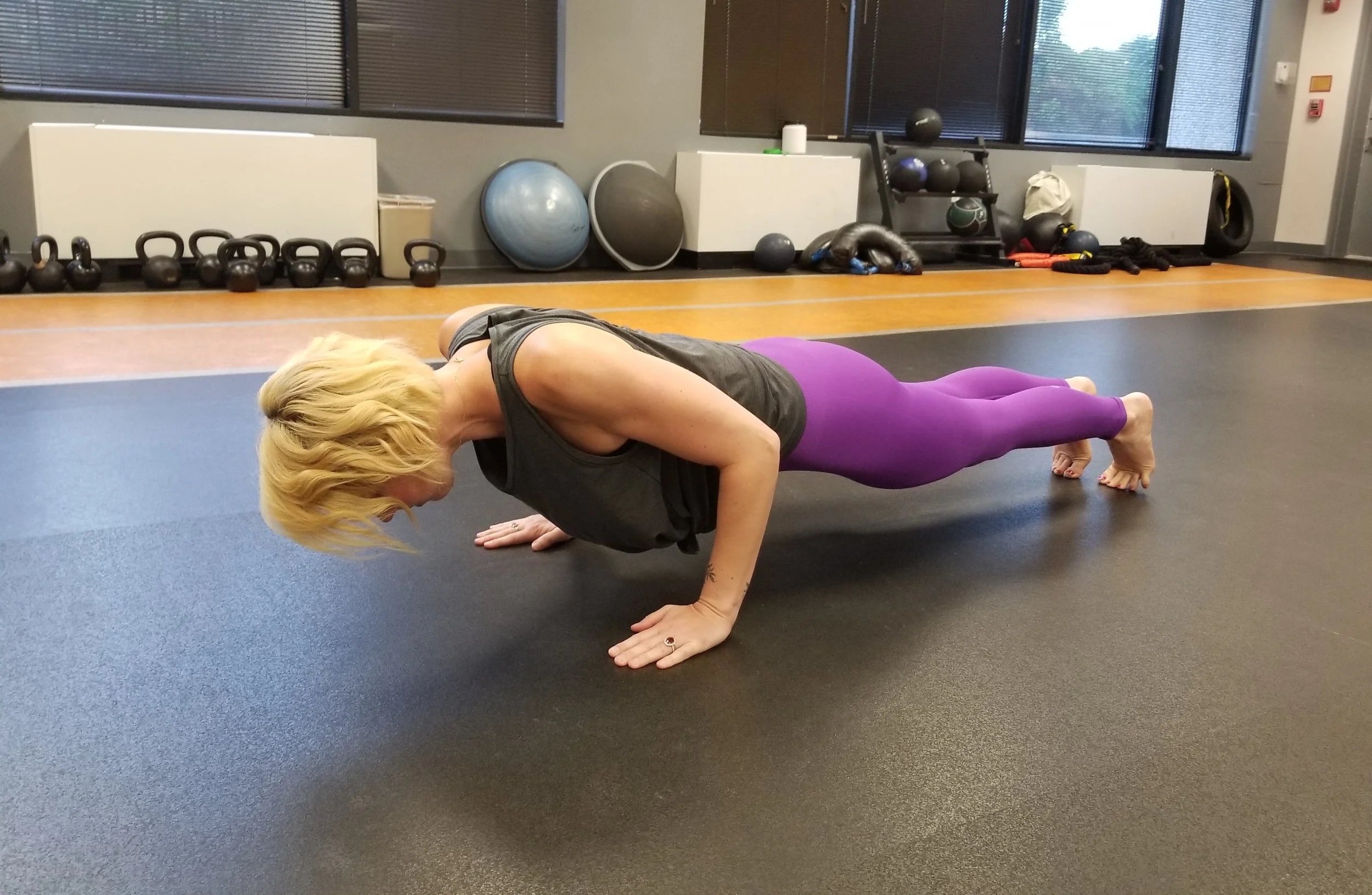
Moving onto the push up, which, done correctly, is an upper body workout AND a core workout. Think plank, but with additional work on your upper body. This combo of strength is what swimming is all about, using your upper body to propel you forward through the water and using your core to stabilize you as you do it.

SwimBox Swimming Lessons Fairfax Swim Lessons Vienna Swimming Lessons Arlington
SwimBox Swim Lessons Arlington Falls Church Swimming Lessons Swim School
SwimBox Swim Lessons Arlington Swimming Lessons Vienna Swim Lessons

Both of these exercises can be done without the use of weights and take up very little time. Try adding them to your workout routine 2-3 times a week to start strengthening your swimming muscles. In the beginning you might not notice a difference, but as you progress and get stronger you’ll definitely see some changes in and out of the water. Most notably for me is that I now understand the feeling I’m looking for when I pull during freestyle (which I definitely didn't when I was growing up and swimming 10 times a week).

Doing these dryland moves in conjunction with your normal swim workouts is not only a great way to add strength, but also to give you more body awareness of the movements you’re making in the water.

Jarrett Brumett Guest Series Post #2: How Strength Training Helps You Recover

You just finished a week of your highest volume in the pool yet and you’re drooling over next week’s taper. The taper hits, but you’re still feeling like your limbs are lead. Not only that, but your coach has a dryland session planned for you later and you’re shaking in your Speedo just thinking about trying to lift later. One of two things are going to happen. #1 You hobble out of dryland feeling even worse than before and look for the nearest pillow to cry into. #2 You walk out feeling fresh and re-invigorated from the special methods that were thrown in to help your system recover. How do you accomplish #2? I’m glad you asked.

SwimBox Blog Swimming Lessons Alexandria Adult Swim Lessons Swim Training Swim Team NOVA

How Dryland Can Help Your Recovery

We’re so used to thinking of dryland to increase our strength and explosiveness that we rarely look at other potential physiological benefits. Like how it can bring balance back to the autonomic nervous system, increase delivery of blood to recovering tissue, and provide a nice mental break from the repetitiveness of your competition season. There are several ways that this can all be accomplished, the key is to understand some of the physiology at play in order to best implement all of these benefits. 

There are two main physiological systems that I view as being able to be influenced in the weight room for recovery: The Autonomic Nervous System and the Circulatory (cardiovascular and lymphatic) System. Both of these are powerful influences in ensuring that you, the athlete, are fully recovered. They also directly play with your tissue quality, nutrient absorption, and inflammatory profiles. And both have specific ways to maximize their function for recovery.

Working with the Autonomic System

The Autonomic Nervous System (ANS) is comprised of two parts: the sympathetic (think fight or flight) and parasympathetic (think rest and digest) systems. A common problem when you're over-worked is that you become stuck in a state of sympathetic dominance. Meaning, your parasympathetic system is not performing well and you're never tapping into a good recovery-driven state. The curious thing is that you can also have the sympathetic system be dampened so that you can’t tap into what you need to perform optimally. Or, you could even have it so that they both suck and everything is screwed. It’s never a black and white problem, and as more research comes out, we are starting to see just how complex everything is. One common theme that keeps getting driven home, however, is the need for balance and the importance of developing a good system solely meant to seek out this balance.

This can be done over time with good warm-up and cool-down protocols in every training session. But you need to 100% emphasize this element when creating a program that facilitates recovery. Creating an athlete that can easily turn up or tone down is crucial and can be done by programming with some of the following methods.  

Parasympthetic Coaxing

The 100% best way to improve the function of your parasympathetic nervous system is through breathing drills. In my last post I touched on their importance as well, so I’m not going to beat a dead horse. But starting your session with a postural-based breathing drill and ending it with a relaxing, decompressive breathing drill will go a long way. My personal favorite drill for ALL ATHLETES to perform at the end of their cooldown is Feather Breathing.

Another great way is to put an emphasis on low-threshold, somatic movement (easy and reflexive movement). Some light mobility drills can do this, but the key is that they need to be LIGHT. If the drill causes you to hold your breath, it’s not a good fit for this purpose. There should be no need for feed-forward tension, it should be reflexive and comfortable. I’ve actually found some drills of this style to be very useful for increasing mobility when done correctly, even though they don’t put anything on stretch. Your movement quality and fitness-level will highly influence what is right for you, but there are a few go-to’s that I use for everyone:

Sympathetic Coaxing

As I said earlier, sometimes the sympathetic system may be dampened and needs to be revved up. But, even if it doesn’t, revving it up enough just to stimulate the system can be a very powerful recovery tool. Either way, the key is to give it just enough stimulus without creating more metabolic stress. There are two different ways I like to perform this depending on where you are in your performance schedule and what my overall goal is for the session.

If the goal is still to create a training stimulus, it's best to use a form of dynamic-effort work, as it will still help improve force output. This means that none of your lifts will exceed ~70% of your max, and are done for lower reps and higher sets. This is commonly used in powerlifting circles to help with enhancing recruitment of muscles and rate of force development without adding stress to your system. It’s also good for working on motor patterns that need practice since all these movements are performed with very little fatigue. The trick is to find a total-body movement that is a beneficial for your specific sport, which in this case, is swimming. Personally, I use pushup and pull up variations, or a trap-bar deadlift for my swimmers. With athletes that don’t have true One-Rep-Maxes (in terms of lifting), it highlights the importance in recording training weights and knowing roughly how much weight an athlete can move at a particular rep range. I have found that in general, a resistance that they have previously done for a hard set of 8-10 reps will be about what they should use for dynamic effort. So if one of my teenage female athletes needs a band to perform 8 pullups, she will use that same banded assistance to knock out this method. And the same is true for the opposite end of the spectrum. If an athlete does pushups with 45lbs on their back for a hard set of 10, they will use that same weight for a dynamic effort day.

Programming this is simple, you want to do 6-10 sets of 1-3 reps with anywhere between :30 - :60 seconds rest. You then coach them to perform each rep with the tension and force as if it was a max effort lift.

The other method I will use to stimulate the system is High Resistance Intervals. Ideally this method is performed with a heart rate monitor, but can also be effective with a timed interval. For this method, you choose a ballistic-style movement that never reaches top velocity and also lacks any eccentric loading (read as the lengthening portion of the lift, as in the lowering into a squat).

Swimming Lessons SwimBox Swim Coach SwimBox Blog

The eccentric portion of a lift is what is known to create the most micro-tears in the tissue. By removing this portion you are significantly lowering the stress of the movement. You perform that movement, at an intense pace for :08 - :10 seconds, then rest until the heart rate has reached an ideal, rested rate. This ideal will be different for each athlete, but 120 bpm is usually a safe bet for most. The other option is to perform “every minute on the minute,” in which you do your :08 - :10 seconds of work, then active recovery for the rest of the minute.

My personal favorite movement for this method is Rope Slams, as seen below, and then I use specific active recovery drills, as you will see in the next section.

Working with the Cardiovascular and Lymphatic Systems

In a simplified view, these systems work together to not only transport nutrients to your tissues, but also to transport byproducts from your tissue to be processed. So to maximize their influence on recovery, you ideally want to help mobilize nutrients/byproduct and increase fluid flow.

The simplest way to do this is to foam roll. And not even the hardcore foam rolling that everyone seems to think is needed to be effective (because yes, that can be pretty painful). Simply spending 30 seconds of some semi-gentle rolling can be enough to help get some blood into some of your tissue.

The next way that’s almost equally as simple is through dynamic mobility drills. I'm using the term mobility drills as I don’t necessarily mean just passive stretching. Passive stretching has it’s time and place, but I’d much rather see some active, dynamic mobility work. The pulsating tension in dynamic mobility movements has the potential to create a pumping mechanism for fluids and stimulate synovial movement in your joints. My two favorites for swimmers are the Adductor Rockback and the Quadruped Lat Mobility.

The final way to help get some fluid movement is through good ol’ fashioned, steady-state cardio. Keeping you heart rate around 130 bpm (again, this is athlete specific) for 30-60 minutes can be very rejuvenating on your system. At this heart rate, it should also be fast enough to create full expansion of the left ventricle and increase the overall stroke volume of the heart, which can also improve the your overall endurance.

SwimBox Swim Lessons Swim Team SwimBox

One trick I use with a lot of my swimmers that combines the last two sections is a method I call the Hybrid Cardiac Output Method. It’s pretty simple, you have the athlete keep up their heart rate to the desired BPM by doing dynamic mobility and medicine ball drills. So long as they don’t hold their breath on any of the drills, you will get the increased left ventricle expansion and you will also help to facilitate more blood flow into the tissues that you’re mobilizing. Win-win.

So, if your coach knows any of these methods, then rest assured, you’ll feel better leaving then when you came in. Not only that, you’ll leave a better athlete than when you came in. Next post I’m going to cover how we can maximize the direct performance benefits of strength training for swimmers. Stay tuned!